

What wasn't working
Tuition and coaching centres run on paper registers, spreadsheets and WhatsApp groups, so enquiries go cold and fees are chased by memory.
Batches, timetables, attendance and marks live in different places, and parents only hear about absences or results when someone remembers to call.
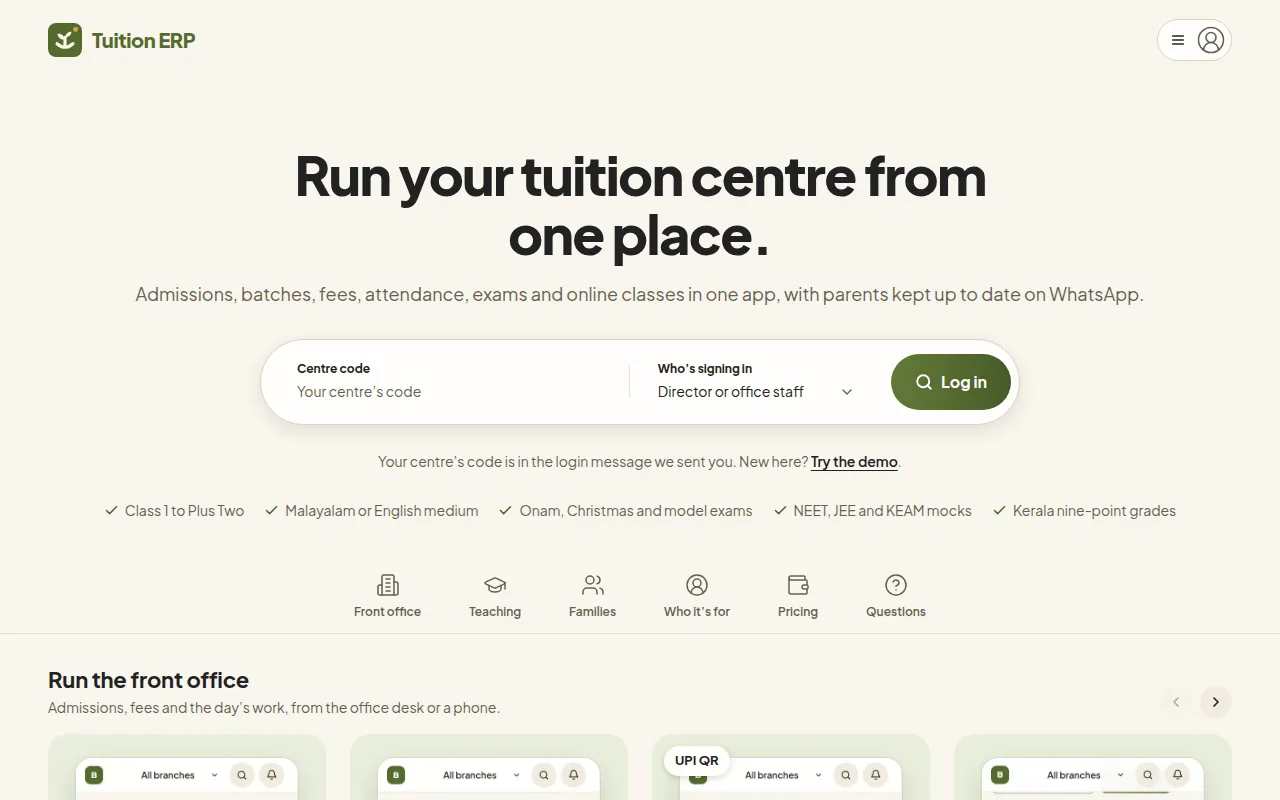
Generic school software does not fit a Kerala tuition centre: Class 1 to Plus Two, Malayalam or English medium, Onam and Christmas exams, NEET, JEE and KEAM mocks.
How we tackled it
Build it as one SaaS where every centre’s data is kept under its own code, so a centre opens in a day with nothing to install.
Follow the centre’s real day: the front office (enquiries, admissions, fees), the classroom (attendance, lessons, tests, report cards) and the family (alerts, results, payments).
Give every role its own sign-in — director, office staff, teacher, student and parent — and let the director decide what each staff member can open.
What we built
- Enquiries followed from the first call to admission, and a Today page with the calls to make and fees to chase.
- Fee collection by cash, cheque, UPI QR or online, with receipts, instalments, concessions and late fees.
- Batches and timetables that catch teacher and room clashes, across several branches.
- Attendance on a phone or by QR check-in, with an alert to the parents of absent students.
- Lessons, study material, homework, doubts, live classes on Meet, Zoom, Teams or Jitsi, auto-marked online tests and report cards with Kerala nine-point grades.
- A parent and student app with one-time-code sign-in for parents, in English or Malayalam.
Where it stands today
- Live at tuitionerp.mexilet.com, with a demo of sample centres at demo.tuitionerp.mexilet.com.
- The front office, the classroom and the family work from the same records instead of registers and chat groups.
- Every centre’s data is kept separate under its own code, and teachers never see what a family owes.
- Plans from ₹1,499 a month, from a single centre up to groups with 50 branches.